Employee Burnout in 2026: Survey Reveals the Real Productivity Crisis in Hybrid Workplaces
Picture this: You're crushing it on a Monday morning — emails flying out at warp speed, meetings nailed with precision, and your to-do list shrinking by the minute. Then, like clockwork, 2 PM hits. Your back starts screaming fr om hours hunched over your desk, your eyes burn fr om the relentless glow of multiple screens, and a thick brain fog rolls in, turning sharp ideas into mush. Sound familiar? This isn't just a bad day; it's the modern office reality, wh ere relentless business hustle clashes head-on with basic human biology. Companies chase maximum output around the clock, but our bodies crave movement, natural light, and strategic breaks to recharge.
With burnout rates spiking to unprecedented levels and teams stretched thinner than ever, that's changing fast. In 2026, USA businesses are waking up to the fact that ignoring workday wellness isn't just bad for morale; it's a direct hit to the bottom line. According to Gallup's latest State of the American Workplace report, disengaged employees cost the U.S. economy up to $550 billion annually in lost productivity. The shift is here: wellness must be woven into the fabric of the workday, not tacked on as an optional perk.
Our Bitrix24 Workday Wellness Survey cuts through the noise, diving deep into the real workday grind faced by over 1,000 Bitrix24 users. We uncovered precise moments when energy crashes, bodies rebel, and focus vanishes — not fr om laziness or lack of motivation, but from fundamentally bad design in how we work.
Spoiler alert: The fix isn't bombarding your team with more yoga apps, standing desk stipends, or mandatory mindfulness sessions. It's rethinking your core tools and workflows to align with human rhythms. Ready to sync your business operations with your team's biological clock? Let's break it down.
The Workday's Hidden Pain Points
Strip away the buzzwords like "burnout" and "quiet quitting." What's the workday really like for the average American worker?
Our survey posed a straightforward question to 1,000+ Bitrix24 users: "What's your top wellness roadblock during working hours?" The responses paint a vivid picture of a body under siege — not from marathons or heavy lifting, but from the subtle tyrants of screens, sedentary seats, and endless digital overload.
Here's the data from the Bitrix24 Workday Wellness Survey, ranked by respondent percentage:
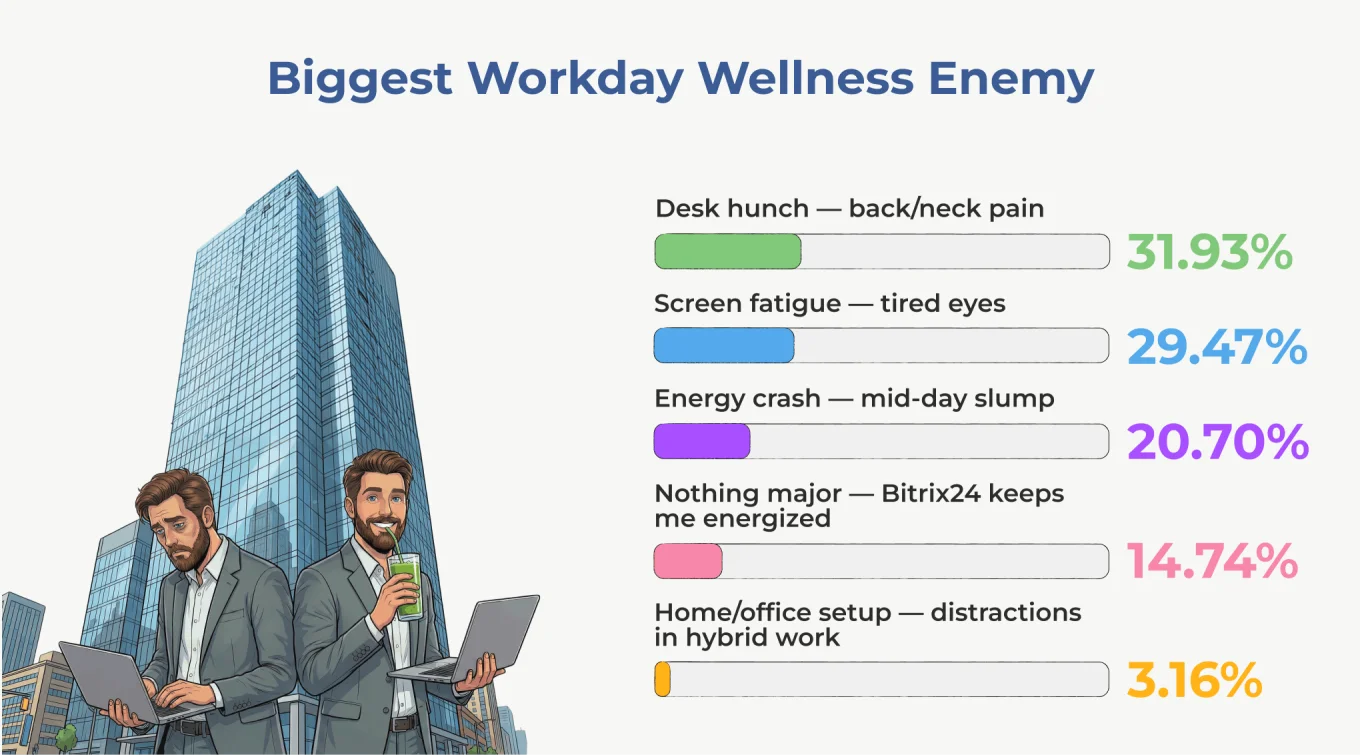
That staggering 31.93% reporting back and neck pain? It's no mystery. Hours of hunching over desks and laptops deliver constant, low-grade stress to muscles, spines, and even nerves.
A groundbreaking 2026 Applied Ergonomics trial proved it definitively: Workers switched to sit-stand desk schedules slashed pain levels by 42% and "presenteeism" — that soul-crushing state of showing up physically but zoning out mentally — in just three months. Posture tweaks don't just ease aches; they boost brainpower by improving blood flow and oxygen delivery to the brain, enhancing cognitive function by up to 15%, per the study's findings.
Visual fatigue, clocking in at 29.47%, stems from endless screen stares interrupted only by more screens. Blue light exposure disrupts circadian rhythms, while constant refocusing strains eye muscles. But here's the game-changer: 14.74% of respondents reported zero major issues. Why them? Their platforms featured smooth workflows, instant info access, and minimal tab-juggling — reducing physical and mental strain right at the source.
The big lesson? Wellness isn't a separate department or HR initiative. It's baked into your work tools. Energized teams aren't the ones stretching more or meditating harder; they're the ones navigating less chaos, with intuitive software that anticipates their needs.
The 2 PM Slump: It's Not You, It's the Dashboard
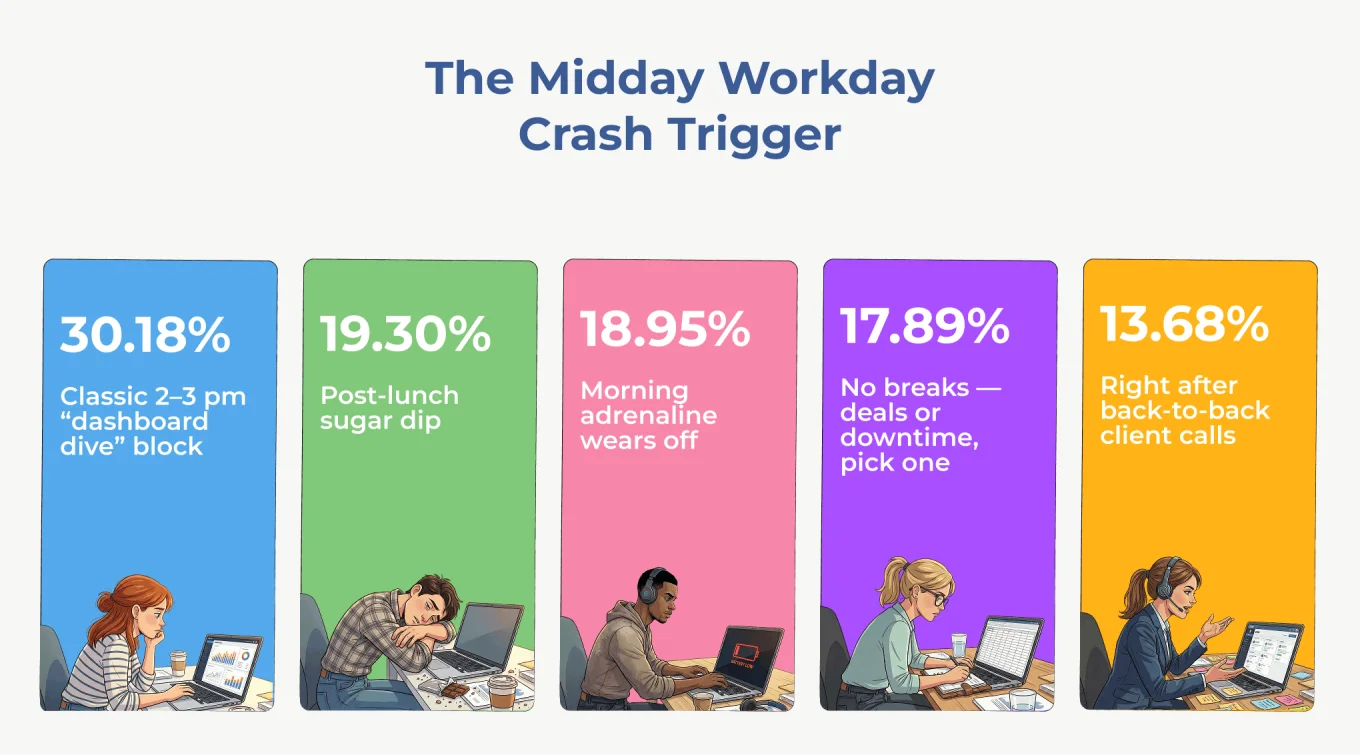
Everyone jokes about the "afternoon slump" — that post-lunch zombie mode wh ere motivation evaporates. Blame the turkey sandwich? Nah, our survey pins the culprit: 30.18% blame the "dashboard dive." That's the brutal transition fr om morning mayhem — endless pings, fire-drill tasks, back-to-back meetings — to finally tackling deep, focused work, only to crash spectacularly.
Think workplace wellness is a "soft" metric? The hard math suggests otherwise. For a typical US firm of 500 employees, ignoring the 2 PM slump represents a massive leak in the annual P&L. When 30% of your workforce loses just one hour of peak productivity daily to digital fatigue, you are bleeding 750 hours of high-value output every week. At an average professional rate of $65/hour, this "minor" afternoon fog scales into a $2.4 million annual hit to your bottom line. By implementing integrated wellness prompts that reclaim even 20% of that lost focus, a savvy COO can inject nearly $500,000 back into the business without adding a single person to the payroll. In 2026, the most profitable companies aren't buying more hours — they are finally optimizing the ones they already pay for.
Science backs it unequivocally. A 2026 Frontiers in Cognition review outlines 10 root causes of decision fatigue mitigation strategies, which, if ignored, obliterate decision speed and quality. Americans make roughly 35,000 conscious decisions daily — mornings burn through them on reactive chaos like email triage and urgent fixes. By afternoon, your mental tank is empty. That bloated dashboard? It's not a helpful to-do list; it's a monument to deferred exhaustion, forcing you to sift through outdated info and scattered tasks. The real solution lies in better cognitive load management — prioritizing how we spend our mental currency before the tank hits zero.
Practical Fixes for Immediate Impact
You don't need a full overhaul to start winning. Stop trying to fix the employee and start fixing the problem. Here's a step-by-step guide to tackle the top issues today:
- Combat Back/Neck Pain (31.93% Issue): Roll out sit-stand desks company-wide. Start with a pilot: Provide adjustable desks to 20% of your team, track pain via weekly pulse surveys, and scale based on results. Expect 30-40% pain reduction in weeks, per ergonomics studies.
- Ease Visual Fatigue (29.47% Issue): Integrate the 20-20-20 rule via apps or browser extensions — every 20 minutes, look 20 feet away for 20 seconds. Pair it with blue-light filters and screen breaks notifications.
- Defeat the 2 PM Slump: Schedule deep work for mornings (9-11 AM) when willpower peaks; reserve afternoons for routine tasks. Use workload views to distribute tasks evenly, preventing overload. Add micro-breaks: 5-minute walks every 90 minutes, backed by ultradian rhythm research showing productivity spikes post-break.
Wellness Tools: What Workers Actually Want
Imagine wellness seamlessly built into your daily software — no extra apps, no context-switching. Would you use it? Our survey says a resounding yes, but only if it's simple and non-intrusive.
Interest in Integrated Wellness Features:
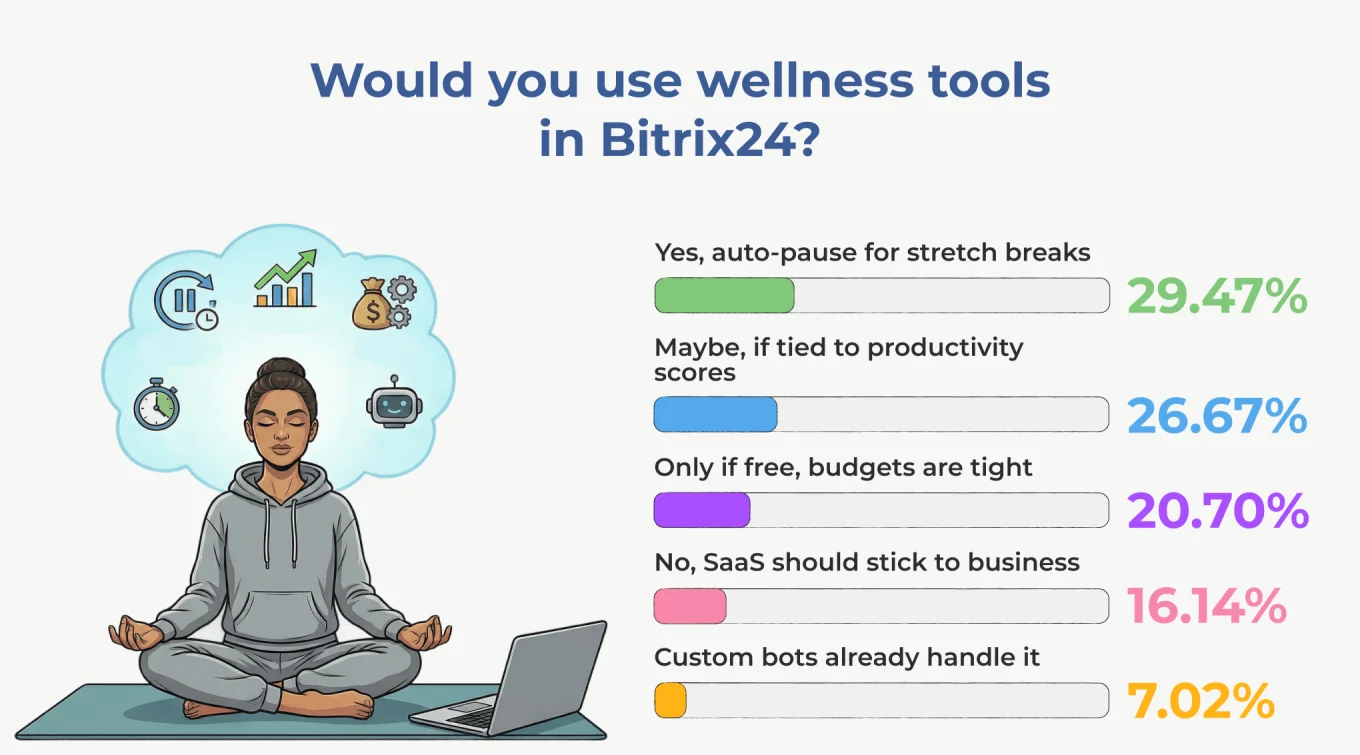
The 29.47% craving effortless prompts want a software "tap on the shoulder" — popping a subtle reminder mid-task: "Time for a 20-second stretch?" No fancy gamification needed. The pragmatic 26.67% demand ROI proof. Wellhub's 2026 State of Work-Life Wellness Report nails it: 89% of workers perform better with health-focused tools; wellness access boosts "thriving" scores from 40% to 61%. Shockingly, 90% faced burnout last year (40% weekly), but wellness users report far better work-life balance (79% vs. 55%).
The 16.14% naysayers aren't anti-wellness; they've been burned by tool overload — yet another notification in an already chaotic inbox. The fix is a shift toward Zero-Knowledge Wellness — systems that provide relief and prompts without storing sensitive personal metrics. By focusing on Privacy-First Bio-Data, companies can offer the 'tap on the shoulder' employees want without the 'Big Brother' vibes they fear. Integrate thoughtfully — focus on relief, not surveillance — or it backfires spectacularly.
Employee voice: Mike from a New York sales team says, "Auto-reminders in my CRM? Yes. But track my every move? Hard pass — that's Big Brother vibes."
Ditch Add-Ons: Build Wellness into Work Design
Wellness apps and stipends are nice gestures, but they pull workers out of their flow to patch damage caused by the workflow itself. DHR Global's 2026 Workforce Trends issues a stark warning: 83% of workers are burned out from excessive workloads, long hours, and life imbalance. Bolt-on solutions treat symptoms; built-in design cures the disease.
Shift to integrated wellness: Embed stretch prompts mid-CRM task, activate focus modes that silence pings during deep work, and deploy energy-tracking dashboards that flag overload before it hits. Use platforms wh ere wellness emerges naturally — no extra logins required.
The Verdict: Redesign or Get Left Behind
So where exactly does the workday go sideways? The answer, from those living it daily, is refreshingly specific. It goes sideways when the body protests — back stiff from static posture, eyes tired from unbroken screen time. It goes sideways when the clock hits 2 or 3 pm and a worker finally sits down to focus, only to find the tank empty. The dashboard dive isn't a failure of willpower. It's the predictable bill coming due for a morning spent in reaction, leaving the deep work account empty.
Less switching and searching means wellness follows automatically. Winners protect attention as their most valuable capital — designing for recovery, not endless grind. Platforms should meet workers halfway, absorbing the pain points and sparking real gains. The path to higher performance isn't pushing harder. It's designing a workday that stops pushing back.
The verdict for 2026 is clear: The most profitable companies will be those that use biomedical and digital data to protect their employees' cognitive energy. Treat attention like gold. Whether its Bitrix24 or any tool that serves as a team's central nervous system, the principle holds: the workday will always demand focus. Stop trying to fix the employee and started using better tools.
Get the numbers you need. Download the complete study PDF, packed with graphics and actionable insights: 2026 Bitrix24 Wellness Survey Results: Building a Healthier Workplace with Integrated Tools